|
< Previous family introduction |
|
|||||
|
|
Family Semelidae Semelids
|
|||||
|
The
family Semelidae consists of about 150 species (Huber, 2010) occurring
mainly in warmer seas, of which about 30 occur in northern Australia,
with only
four extending
as far south as NSW. The family is spread over about 15 genera of fairly
large, whitish and occasionally brightly coloured shells but only three
genera occur in NSW, and these are somewhat atypical of the family. The
genera found in NSW are Theora which are thin, fragile shells
that live buried in mud; then Ervilia that is represented by only
one species up to 7 mm in length; and lastly Rochefortina that is
also represented by only one species, which is very small, with a
maximum length of 4 mm. Semelids
are closely related to the Tellinidae, and live in similar habitats,
buried in sand or muddy sand. The two Theora species found in
NSW, T. lubrica and T. lata, are infaunal mud dwellers,
burrowing in mud in the middle and upper reaches of estuaries, including
Sydney Harbour and Port Hacking. Theora lubrica is native to the
northwest Pacific Ocean and has been introduced to Australia and other
localities worldwide and is regarded as an invasive species capable of
establishing in suitable habitats. It is probably distributed in
ship’s bilge water. Family
Reference The
Australian species were described in 1992, but have been updated by more
recent work: Lamprell,
K. and Whitehead, T. 1992. Bivalves of Australia vol. 1. Crawford
House Press, Bathurst, Australia. Worldwide,
the family was catalogued by: Huber,
M. 2010. Compendium of Bivalves.
ConchBooks, Harxheim, Germany. Coverage All
the NSW species are detailed here. Identification
Notes Shell
Form As
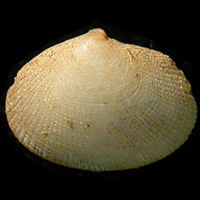
mentioned above, typical semelids are similar in shell form to
Tellinidae, but the posterior flexure is slight. The NSW species are
atypical of the Semelidae in general, being small and fragile in the
case of Theora and very small (up to 4 mm) for Rochefortina. Hinge
and Ligament The
ligament is in two parts; an external part is attached to nymphs, while
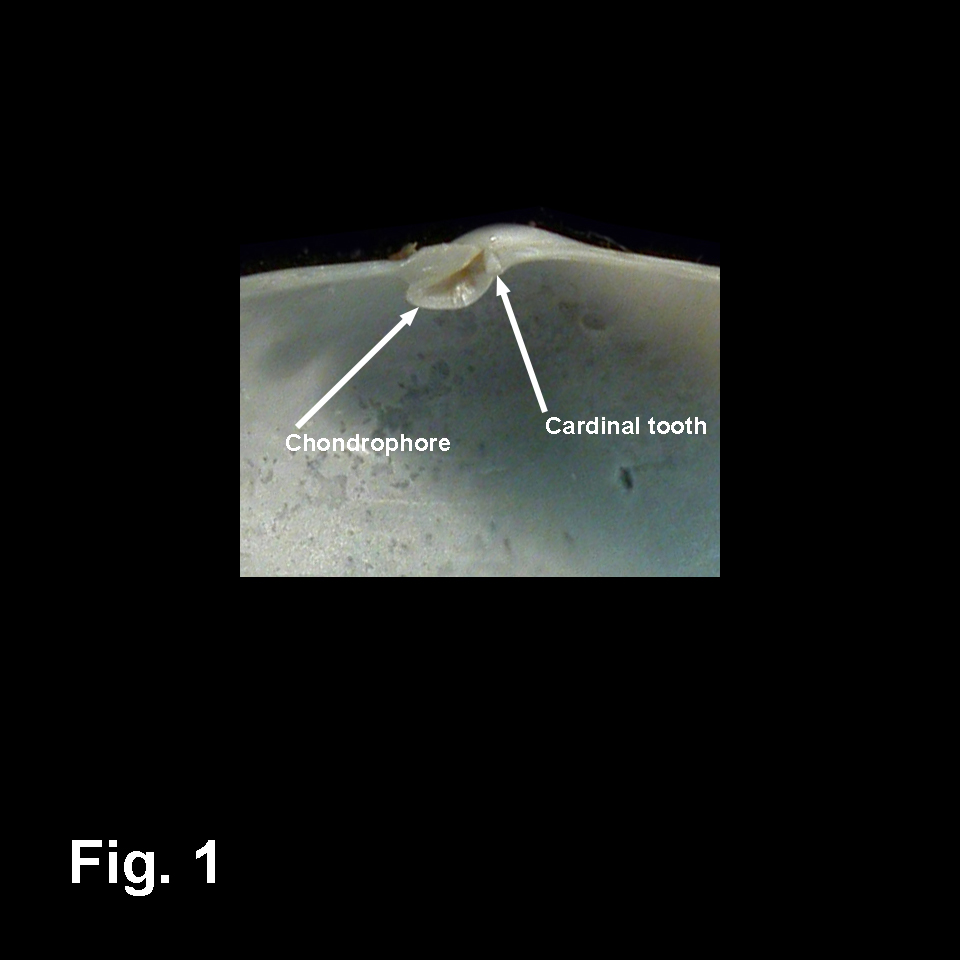
the internal part is sunken in a pit on the spoon-shaped chondrophore
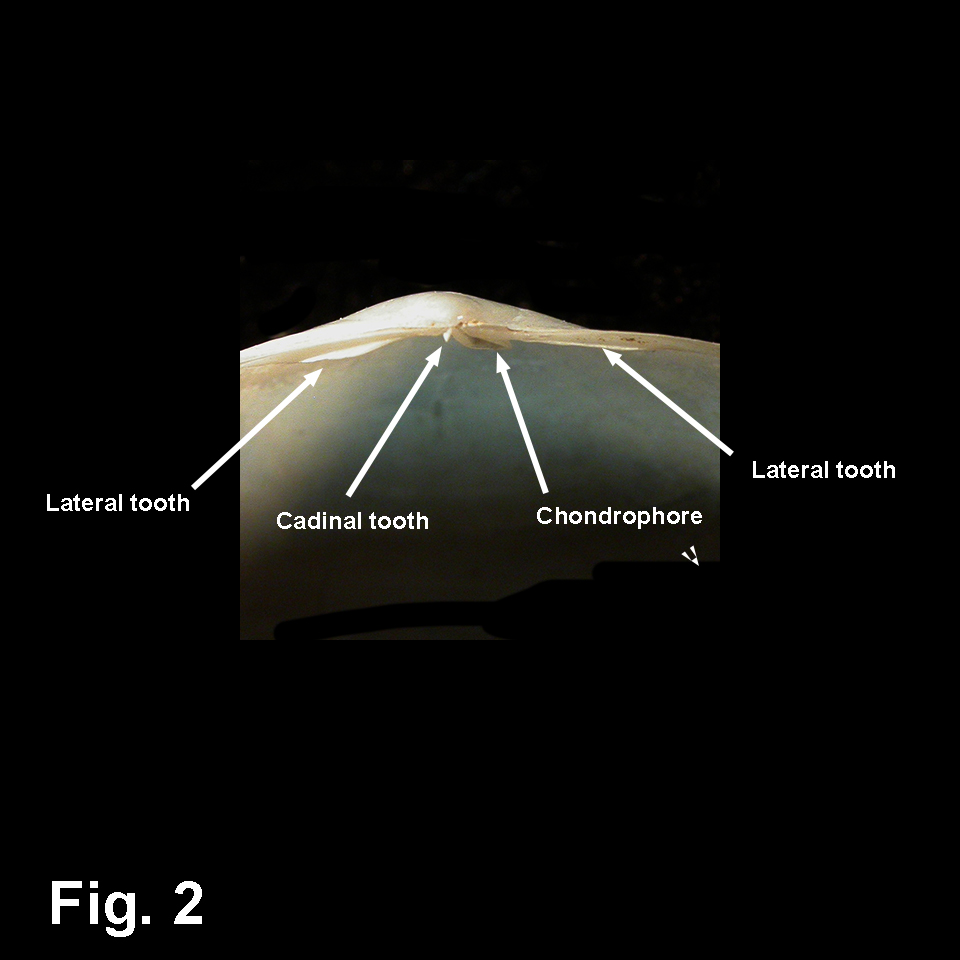
that projects into the shell cavity (Fig. 1). The hinge teeth consist of
one or two cardinals and two laterals in each valve (Fig. 2). Shell
Interior The
shell interior shows the scars of the anterior and posterior muscles,
and a very large pallial sinus, extending past the shell midline. The
pallial line and sinus are often difficult to discern. Fig.
1: Hinge of Theora lata
left valve showing chondrophore and cardinal tooth in end view.
(C.378034). Fig.2:
Hinge of Theora lata right valve showing cardinal tooth in
end view, two lateral teeth and chondrophore (C.378034). |