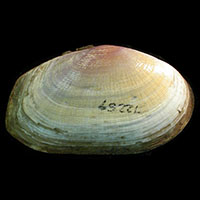
|
< Previous family introduction |
|
|||||
|
|
Family Psammobiidae Sunset clams
|
|||||
|
The
Psammobiidae is a medium-sized family of about 100 species (Huber, 2010)
distributed worldwide in mainly tropical regions. It is well represented
in the Indo-West Pacific Ocean, including northern Australia. In NSW
there are seven species recorded; four of these are endemic to Australia
with a southern Australian distribution, while the other three have a
tropical Indo-West Pacific distribution and only extend southwards into
northern NSW. Psammobiids
are burrowing bivalves, living in sand or mud in a range of situations.
In NSW, one species is restricted to river estuaries, several prefer
sand flats in sheltered waters, while one species shows a preference for
regions of strong water flow. At
least two species live very shallowly, restricted to the intertidal zone
or a few centimetres below. Anatomically,
psammobiids are very similar to tellinids. They have a pair of long
siphons posteriorly which are extended to the surface to draw in the
sediment and to expel waste. They are deposit feeders, drawing in a
stream of water laden with food particles among other debris, and
ejecting a stream of rejected particles in the outward water flow. Family
Reference The
family in Australia was revised by Willan (1993) Willan,
R.C. 1993. Taxonomic Revision of the family Psammobiidae (Bivalvia:
Tellinoidea) in the Australian and New Zealand region. Records of the
Australian Museum Supplement 18. Coverage All
the species of the family recorded from NSW are covered here. Identification
Notes Shell
form Shells
in this family are moderately large, elongate and fairly fragile. The
family is closely related to the Tellinidae, but there is no posterior
flexure of the shell as in Tellinidae. Hinge
and Ligament The
hinge has one or two cardinal teeth in each valve, but lateral teeth are
absent in this family. The
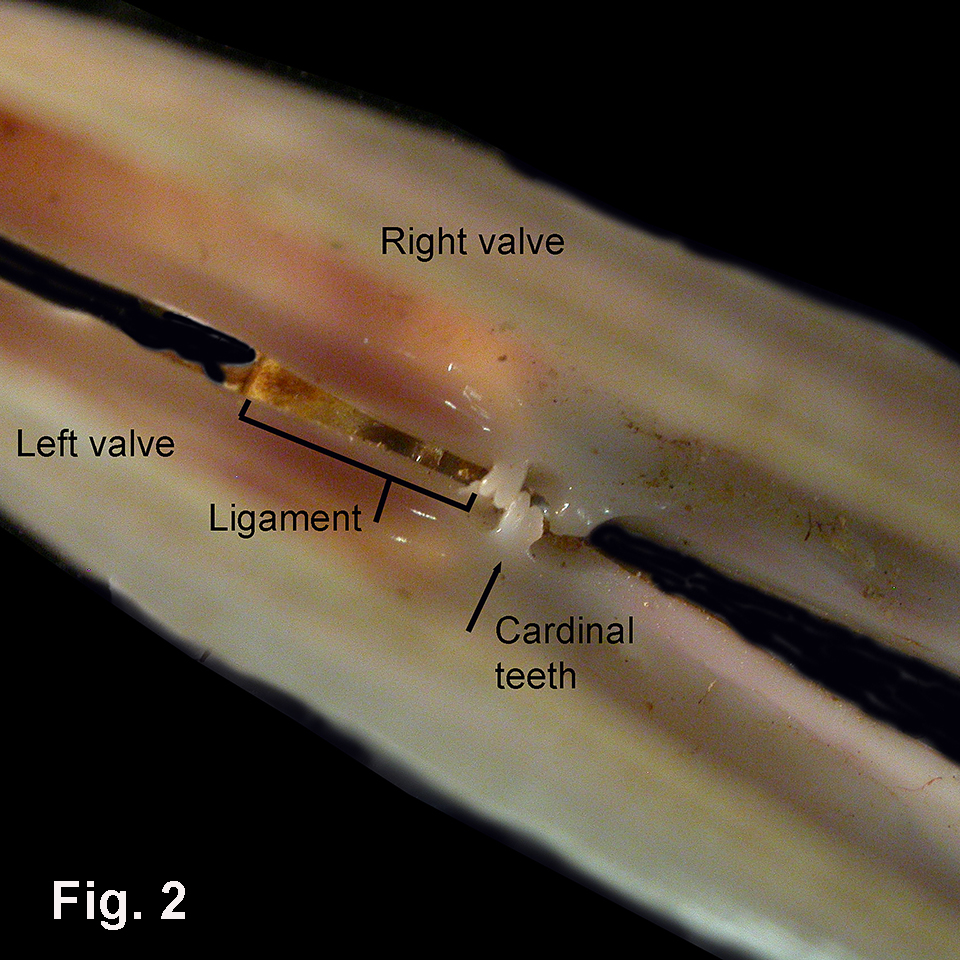
ligament is external, attached to nymphs which project above the dorsal
margin, behind the umbo. Fig. 1 shows an internal view of a conjoined
pair of Gari livida, with detail of the hinge plate; the ligament
in the middle and the cardinal teeth – two in the right valve and one
in the left valve. Shell
Interior The
shell interior shows scars of the anterior and posterior adductor
muscles, and a very large pallial sinus, extending to or past the shell
midline. The shell margin is smooth. Acknowledgement This
work relies heavily of the treatment of the family by Dr Richard Willan,
as given in the Family Reference above. In some cases, particularly the
habitat and distribution of species, Dr Willan’s work is quoted
directly; such quotations are not referenced individually but are
recognised here. I express my thanks to Dr Willan for allowing use of
his work and his substantial assistance with the text. Fig.
1 Internal
view if Gari livida showing hinge and cardinal teeth (C.074201)
|