|
|
PSAMMOBIIDAE |
|
|
Click on an image to enlarge
|
Hiatula
alba
(Lamarck, 1818) Description:
Shell
lightweight, fragile. Shape elongate, laterally
compressed, umbo behind midline. Anterior and posterior ends smoothly
rounded, ventral margin smoothly rounded. Exterior surface shiny,
smooth except for weak growth lines. Interior with muscle scars,
pallial line and pallial sinus well defined; pallial sinus extends
three-quarters of shell length. Pallial sinus purple, rest of interior
white when not weathered. Hinge right valve with 2 delicate
cardinal teeth, rear one bifid; left valve with 2 delicate cardinal
teeth, rear one only a low lamella.
Ligament fairly short, attached to nymphs that project above
dorsal margin. Shell colour purple and white, posterior
end often white. Periostracum thin, smooth, brown. Size:
Up to 50 mm in length. Distribution: Endemic to Australia: Hervey Bay, Qld, southwards and around southern Australia to Dampier Archipelago, WA, including Tas. Habitat:
Lives in mud or muddy sand in protected
situations, down to 0.5 m depth, buried shallowly to 6 cm deep. Synonymy: This species was placed in the genus Soletellina until recently. Because of its wide distribution and variability in shape and colouring, nine specific names have been applied to this species. These include Soletellina donacioides Reeve, 1857 and Florisaka onuphria Iredale, 1936. Remarks:
This is
another case where the species name does not reflect the character
of the shell. The species epithet “alba” was applied to a whitish
South Australian form before it was recognised this was a form of a
widely distributed species that is usually purple-brown. Being the first
name applied, it is correctly used for
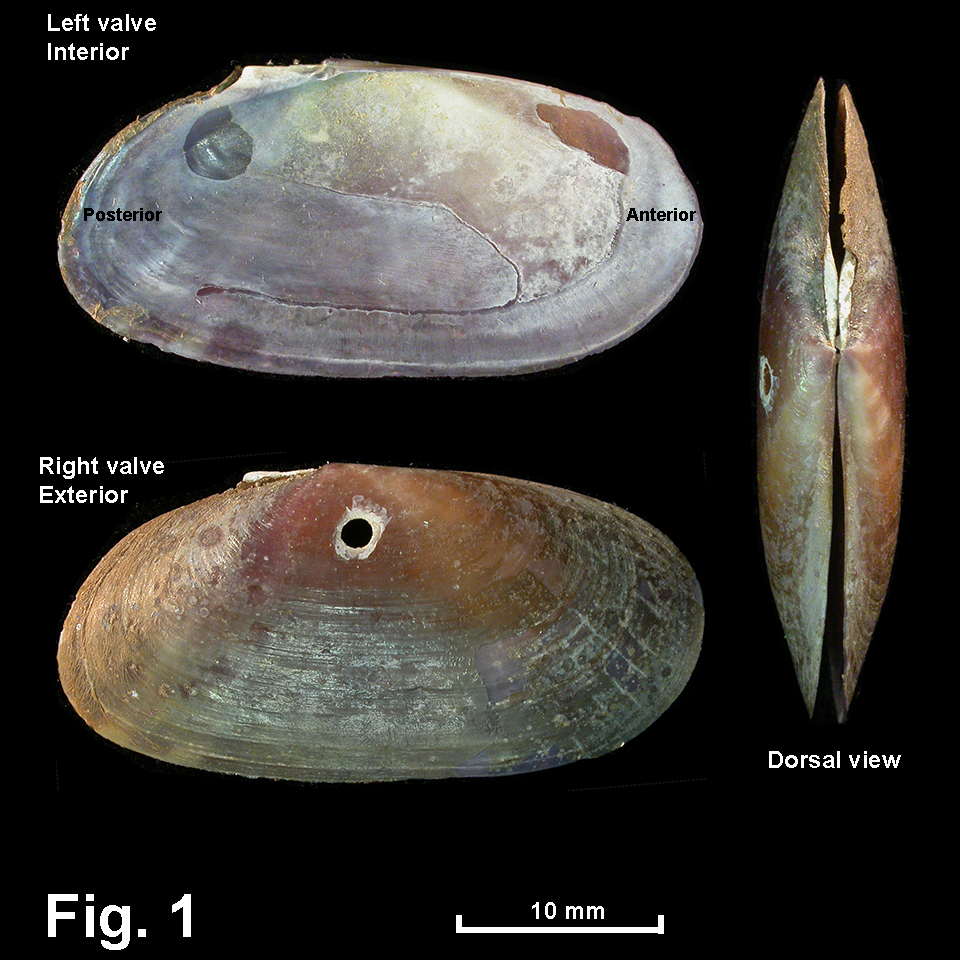
the entire species. Fig. 1: Gunnamatta Bay, Port Hacking, NSW (C.324000). Note that the circular hole in the right valve was made by a predatory gastropod, probably a Conuber sp. (Naticidae). |
|