|
< Previous family introduction |
|
|||||
|
|
Family Hemidonacidae Hemidonax
|
|||||
|
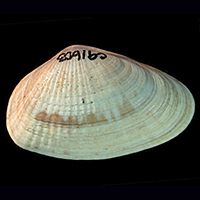
Hemidonacidae is a numerically small family of moderate sized shells. It contains only the genus Hemidonax, which itself contains only six species. The family is restricted to the central Indo-West Pacific Ocean, with one species found in the Philippines-Indonesia region and the rest restricted to Australia. Only two species occur in NSW, these having a distribution from northern Queensland southwards to southern NSW. This is an unusual distribution which contrasts with the usual situation of Indo-West Pacific species which occur throughout the Indo-West Pacific and extend southwards into northern NSW. The habitat of hemidonacids is not known with certainty, but they most likely burrow shallowly in clean sand in the shallow subtidal zone. They live sufficiently shallowly to be washed up on beaches, sometimes in quantity. Family Reference Ponder, W.F., Colman, P.H., Yonge, C.C. and Colman, M.H. 1981. The Taxonomic position of Hemidonax Mörch, 1871 with a review of the genus (Bivalvia: Cardiacea). Journal of the Malacological Society of Australia 5(1-2): 41-64. Coverage The only two species that occur in NSW are detailed here. Identification Notes The Hemidonacidae have shells similar to Cardiidae but with a triangularly elongate-oval shape.
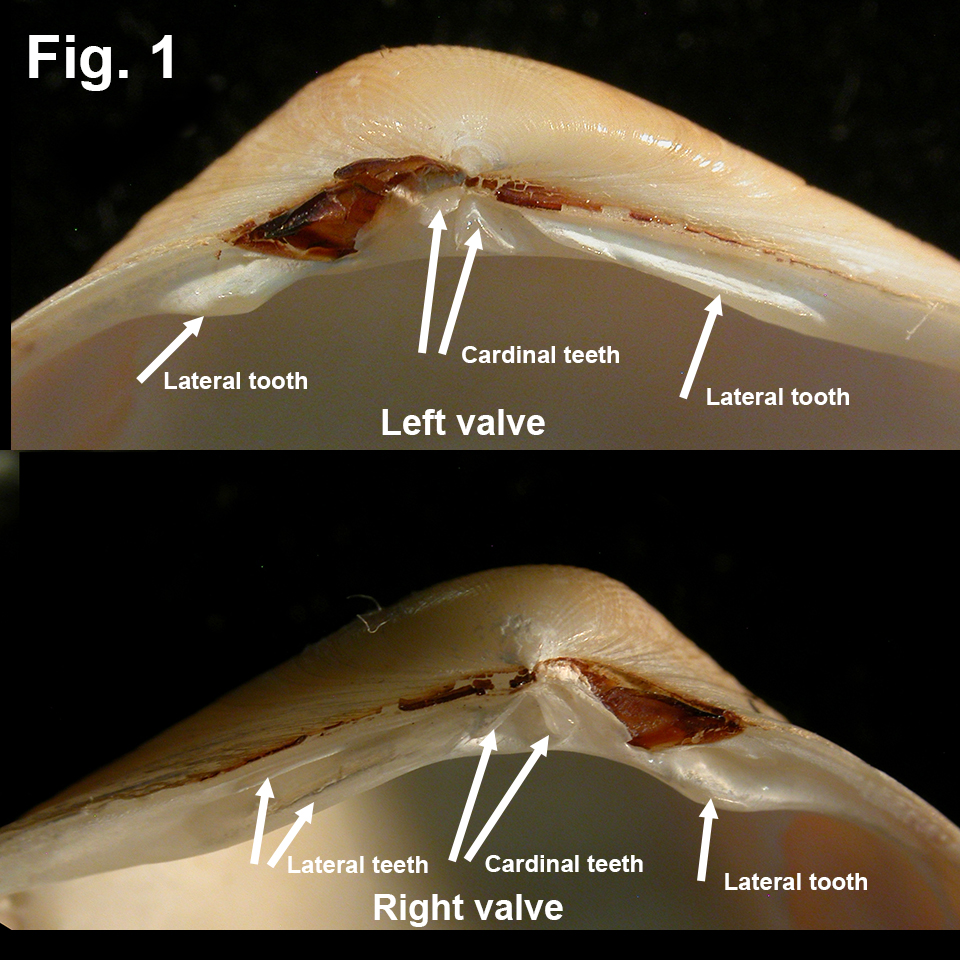
Fig. 1: Hinge of Hemidonax pictus
|