|
< Previous family introduction |
|
|||||
|
Family Cardiidae Heart Cockles
|
||||||
|
The Cardiidae is a large and well known family of more than 250 species (Huber, 2010). Shells are medium to large with most species larger than 30 mm, although a few are less than 10 mm. The family is of worldwide distribution with more than half of the species occurring in the Indo-West Pacific region (of which NSW is at the southern edge). There are seven species recorded from NSW; three of these occur in the tropical Indo-West Pacific and just extend into NSW from the north, three other species occur around southern Australia and extend into NSW from the south. The seventh species has a narrow distribution from southern Queensland to central NSW. Most cardiids live shallowly buried in sand or mud; the animal has a large muscular foot that is used in burrowing. They position themselves vertically, with the posterior edge of the shell just below the surface, so that the siphons project into the water above. In NSW, most live in the shallow subtidal, down to around 100 m, but one species Pratulum thetidis extends down to 300 m. Most NSW species live sufficiently shallowly for shells to be occasionally washed up on beaches. Family Reference Lamprell & Whitehead’s Bivalves of Australia Vol.1 treat the Australian species. A recent comprehensive treatment of the family worldwide is Jan Johan ter Poorten’s monograph A Taxonomic Iconography of Living Cardiidae. Coverage All the species that occur in NSW are treated here, with the exception of the following:
Identification Notes The NSW species are characterised by:
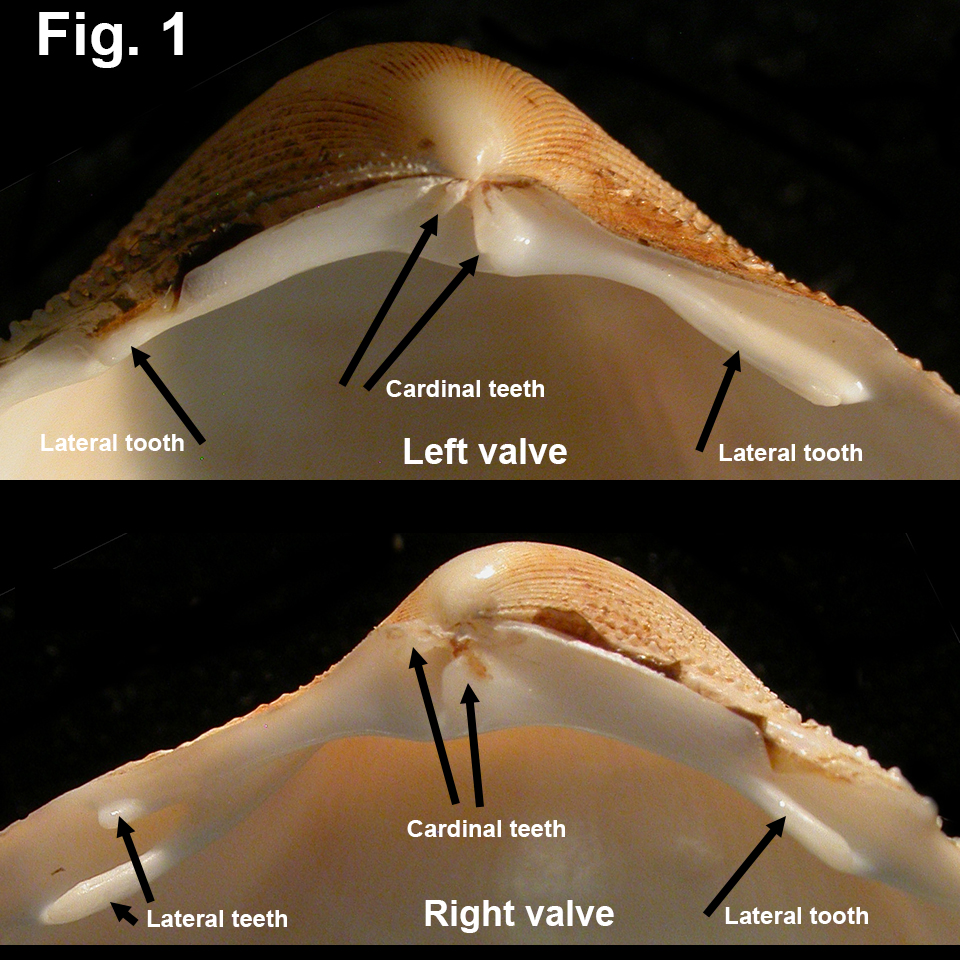
Fig. 1 Hinge of Acrosterigma cygnorum
|