|
|
DONACIDAE |
|
|
Click on an image to enlarge
|
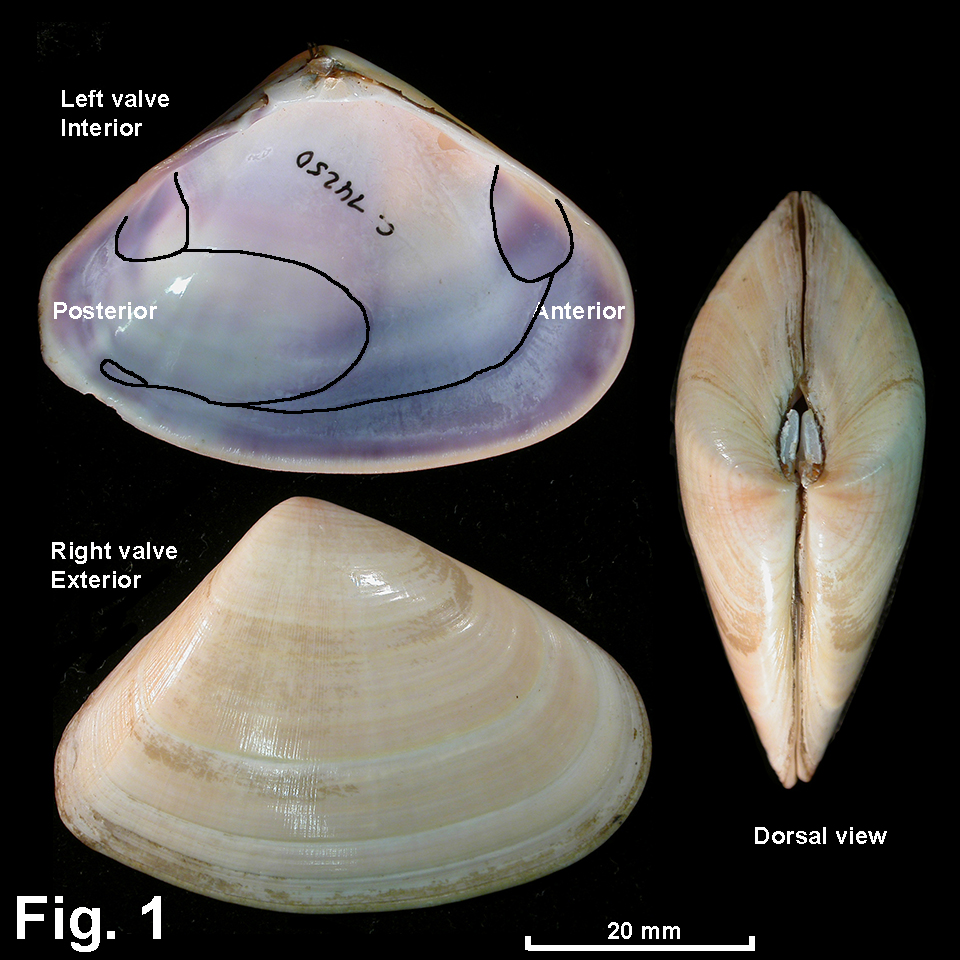
Latona deltoides (Lamarck, 1818) Description: Shell solid and heavy. Shape
triangular, umbo on midline; anterior end broad and rounded, posterior
end truncate, dorsal margin smoothly rounded. Exterior polished,
with weak irregular commarginal growth lines and very fine radial ridges
posteriorly. Interior with muscle scars and pallial line well
defined, pallial sinus reaching to midline;
margin smooth. Hinge strong; right valve with massive, bifid
cardinal, left valve with 2
cardinals, both valves with laterals each side (Introduction, Fig. 1).
Ligament in 2 parts; central part attached to nymphs, other
part in elongate groove. Shell colour internally purple and
white; externally, irregular concentric bands of creamish white, fawn or
brown often tinged with purple. Periostracum thin, brown. Size: Up to 62 mm in length. Distribution: Endemic to Australia. Hervey
Bay, Qld, southwards and around southern Australia, to central SA.
Lamprell & Whitehead (1992) incorrectly reported the range as all
Australian states and NT, but the
author has not seen records or specimens to support this statement. Habitat: Lives in the surf zone of sandy
beaches where it is common, sometimes abundant. Commonly known as the
pipi in NSW (and Goolwa cockle in South Australia, and eugarie in
Queensland), these bivalves are collected from the surf zone of sandy
beaches and used as food and bait. They are capable of re-burying
rapidly when washed out by waves. Comparison: Synonymy: The species was previously known as
Donax deltoides Lamarck, 1818 or Plebidonax deltoides (Lamarck,
1818). Fig. 1: Narooma, NSW (C.74250) |
|