|
< Previous family introduction |
|
|||||
|
|
Family Mesodesmatidae Wedge Clams
|
|||||
|
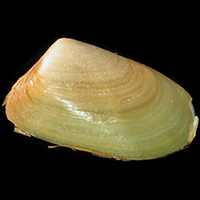
The Mesodesmatidae is a numerically small family of wedge-shaped bivalves, worldwide in distribution but most common in Australia and New Zealand. Indeed, in New Zealand some large mesodesmatids are ecologically (such as Paphies australis) and culturally (P. ventricosa) extremely important. The family has about 30 species (Huber, 2010), only three of which occur in NSW. Species occur in marine and estuarine environments, shallowly burrowing in sand like their ecological equivalent Donacidae. One of the NSW species is a common inhabitant of the surf zone on exposed ocean beaches where individuals actively burrow after being washed out of the sand by the waves. The second NSW species occurs in sand in more sheltered harbours and bays. Mesodesmatids are similar to mactrids anatomically in having a large foot which is used for burrowing, and extensible paired siphons, but unlike mactrids those of mesodesmatids are nearly or completely separated and have papillate around their tips. The animals live buried in the sand with the siphons projecting up into clear water which they draw in and pass over the gills to extract oxygen and food particles. Family Reference The Australian species were catalogued by Lamprell & Whitehead (1992). Coverage All the NSW species are described here. Identification Notes Shell form Shells are small to medium, up to 30 mm in length in NSW, trigonal, compressed tending to ovate. Most species have smooth shells with irregular growth ridges covered with a periostracum to a variable degree. Hinge The hinge is strong, with two cardinal teeth and two laterals in each valve. The anterior cardinal is usually combined with the anterior lateral. The ligament joining the valves consists of a small external section supported by a nymph in each valve but the internal ligament fits into a deep, inward-directed or oblique socket (a chondrophore) that lies immediately under the umbo. Shell Interior The two muscle scars and the pallial line are clearly defined. The pallial sinus is fairly shallow, only about one-quarter of the shell length.
|