|
|
ANABATHRIDAE |
|
|
|
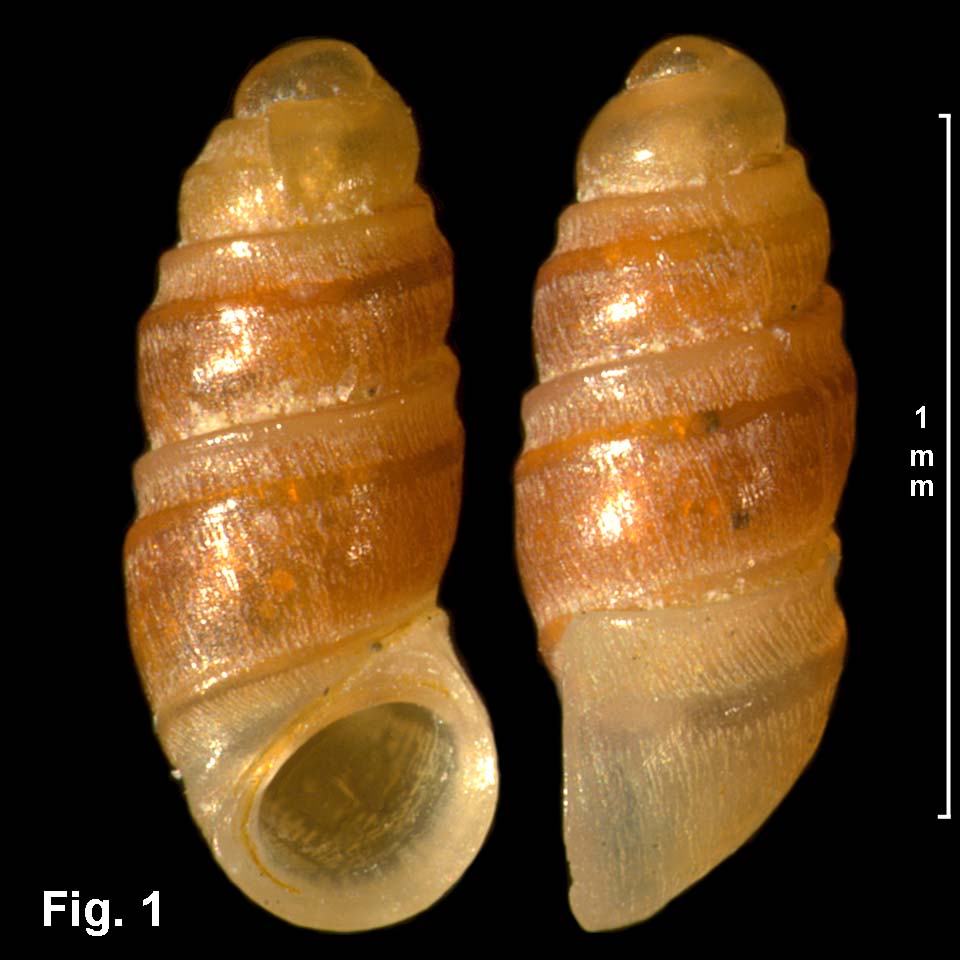
Anabathron lene Hedley, 1918 Description: Shell minute, solid, spire convex in outline. Protoconch paucispiral, rounded, with spiral rows of minute pits, with strong varix forming distinct junction with teleoconch. Teleoconch whorls with smooth, polished keel immediately below suture and another at upper third of whorl; whorls concave between keels, convex below; another keel at base of last whorl. Axial sculpture restricted to dense growth lines. Aperture ovate, with no anterior or posterior channels. Inner lip of aperture slightly separated from previous whorl by narrow groove (visible only with SEM). Outer lip thickened but smooth internally. Umbilicus closed. Size: Up to 1.25 mm in length. Distribution: Endemic to Australia: Noosa Heads, Queensland, southwards and around southern Australia, to south-western WA, including Tasmania. Habitat: Empty shells are moderately common in beach washup and uncommon down to about 20 m. Living specimens are known from algae and rock washings, from the low intertidal down to about 10 m. Comparison: This species has more rounded whorls than A. contabulatum, and a strong keel immediately below the suture. It is more common than A. contabulatum in Victoria and Tasmania, and very common in South Australia where A. contabulatum does not occur. Synonymy: None. Fig. 1: Little Coogee Bay, NSW (C.351603) |
|